Specify an outdoor LED luminaire by matching its IP rating to the expected dust and water exposure, and its IK rating to the mechanical impacts it may encounter. Then confirm that both ratings apply to the exact enclosure, accessories and installation configuration being supplied.
An IP code describes enclosure protection against access to hazardous parts, solid objects and water. An IK code describes protection against external mechanical impacts. Neither code, by itself, establishes corrosion resistance, vehicle load capacity or suitability for every outdoor environment.
For procurement, the useful question is not simply “Which number is higher?” It is “What exposure does this rating address, and what evidence connects the tested product to this installation?”
Read IP and IK as separate requirements
For an IP rating such as IP66, the first numeral concerns access and solid-object protection; the second concerns water ingress. IP6X identifies a dust-tight enclosure. IPX6 identifies protection against powerful water jets under the specified test conditions.
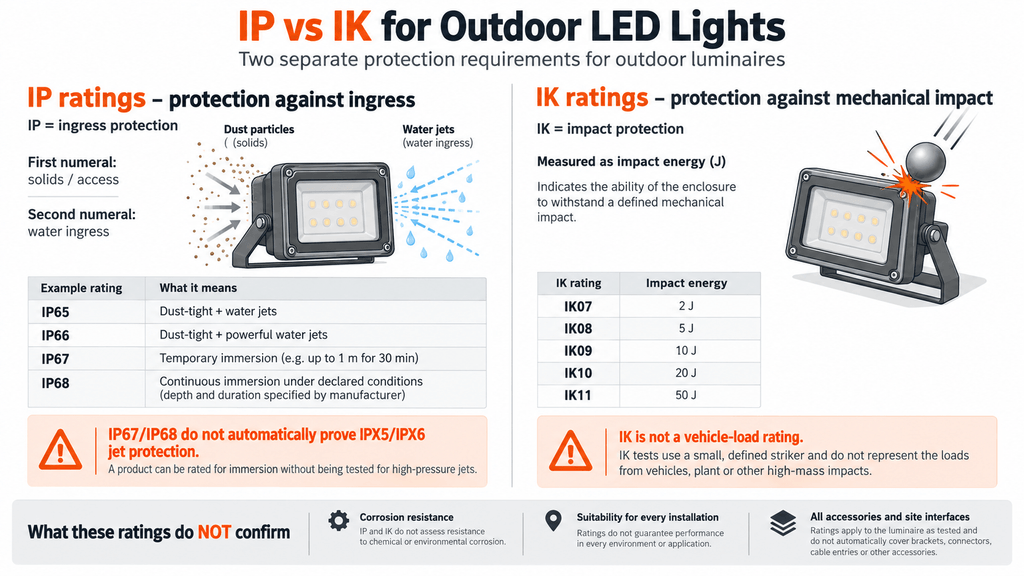
IK uses a two-digit code associated with impact energy, expressed in joules (J). It is a separate classification, not another part of the IP number.
| Rating example | What it identifies | What it does not establish |
|---|---|---|
| IP65 | Dust-tight enclosure with protection against water jets | Suitability for immersion or every cleaning method |
| IP66 | Dust-tight enclosure with protection against powerful water jets | Unlimited pressure-washing resistance |
| IP67 | Dust-tight enclosure with protection against temporary immersion under specified conditions | Continuous underwater operation |
| IP68 | Dust-tight enclosure with protection against continuous immersion under declared conditions | An unlimited depth or an unrestricted underwater application |
| IK08 | Impact classification associated with 5 J | A vehicle load rating |
| IK10 | Impact classification associated with 20 J | Indestructibility or immunity to vandalism |
The relevant international classification standards are IEC 60529 for IP and IEC 62262 for IK. For a project specification, identify the applicable edition and national adoption, together with the relevant luminaire safety requirements. A classification standard does not, on its own, select the appropriate product for a particular site.
Do not treat water protection as a single upgrade ladder
Jet exposure and immersion present different demands. An IP67 or IP68 declaration does not automatically demonstrate compliance with the IPX5 or IPX6 jet tests. Where the installation encounters both, obtain evidence covering both conditions.
This matters when a recessed luminaire may sit in standing water but is also cleaned with a hose. Selecting an immersion-rated enclosure addresses only part of that exposure assessment. Conversely, a jet-rated floodlight should not be assumed suitable for a recess that can flood.
For IP68, request the declared immersion conditions, including depth, duration and any operating restrictions. Confirm whether the proposed use matches them. “IP68” without those details is insufficient to approve a permanently submerged lighting application.
Cleaning also needs its own review. Record the cleaning equipment, nozzle distance, water temperature and any chemicals. A rating derived from a defined water test does not authorize arbitrary pressure-washing or chemical cleaning.
Interpret IK in the context of the tested assembly
Useful impact-energy reference points are IK07 at 2 J, IK08 at 5 J, IK09 at 10 J and IK10 at 20 J. The 2021 amendment to IEC 62262 also includes IK11 at 50 J; IK10 should therefore not be described as the highest classification in that amended standard.
These values identify controlled test energies. They are not equivalent to a permitted vehicle weight, nor do they predict the outcome of every strike by a sharp tool or moving object. Test mounting, impact locations and the enclosure configuration matter.
For a luminaire within public reach, review the exposed glass or diffuser as well as the housing. Ask whether the declared result covers the supplied cover, fixings and any required protective guard. A report for a guarded configuration does not automatically establish the same result without the guard.
Also review the acceptance criteria. The 2021 amendment adds a fallback criterion preventing damage that impairs the specified IP code where other relevant criteria are absent. Separate IP and IK labels do not explain the test sequence or evaluation used for a particular product; the report should make that clear.
Where foreseeable contact is frequent, consider changing the mounting position or adding an approved physical protection detail. A higher IK rating alone may leave the underlying exposure unchanged.
Build an exposure schedule before setting minimum ratings
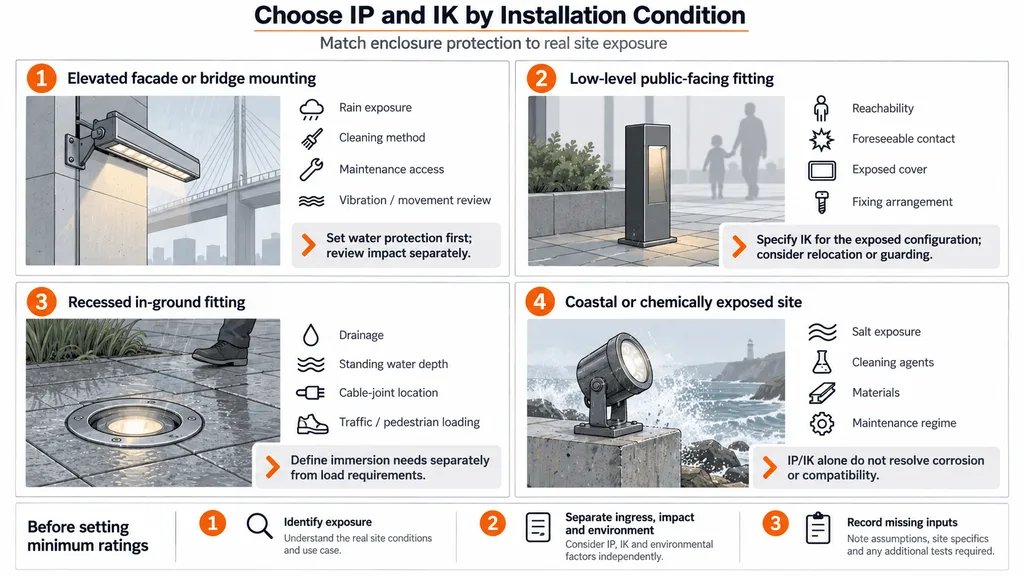
Divide the project into installation conditions rather than applying one protection requirement to every luminaire. Record where water can collect, how maintenance occurs and who or what can reach the fitting.
The following matrix is a specification aid, not a set of universal minimum ratings.
| Installation condition | Information needed | Specification response |
|---|---|---|
| Elevated facade or bridge mounting | Rain exposure, cleaning method, maintenance access and structural movement | Select the required water protection; review impact exposure separately and request mounting or vibration evidence where relevant |
| Low-level public-facing fitting | Reachability, foreseeable contact, exposed cover and fixing arrangement | Specify the required IK performance for the complete exposed configuration; consider relocation or guarding |
| Recess in paving or landscaping | Drainage, possible water depth and duration, cable-joint location and traffic | Establish immersion requirements and separate pedestrian or vehicle-load requirements |
| Coastal or chemically exposed location | Salt exposure, cleaning agents, materials and maintenance regime | Add material, coating and compatibility requirements; IP and IK do not resolve these questions |
Use the schedule to create separate acceptance lines for ingress, impact and any additional environmental demands. For example, write the immersion conditions alongside the ingress requirement, and identify the cover and mounting arrangement alongside the impact requirement.
If a condition is unknown, record the missing input and who must resolve it. Do not replace an unknown flooding duration with a larger IP number and assume the uncertainty has disappeared.
Check whether the supplied configuration matches the evidence
A protection rating is useful only when the evidence can be traced to the product being ordered. Use the following review sequence before approving a substitution or issuing a purchase order.
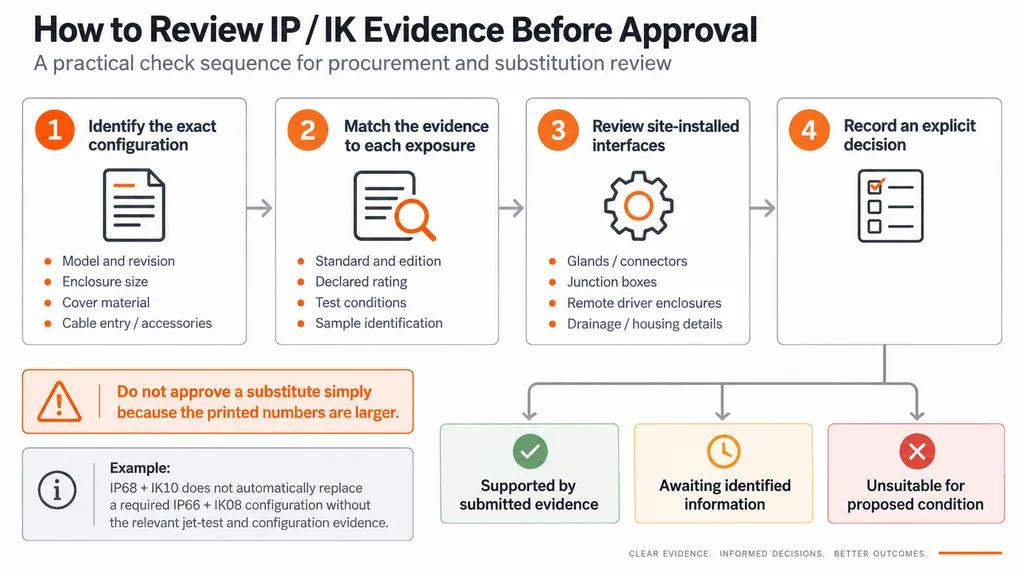
1. Identify the exact configuration
Record the model and revision, enclosure size, cover material, cable-entry arrangement, external driver if used, and required mounting accessories. Ask the supplier to identify which configuration the IP and IK evidence covers.
Where one report represents a product family, request the basis for including the proposed variant. Similar appearance is not sufficient evidence that different covers, seals or enclosure sizes perform identically.
2. Match the evidence to each exposure
Check the reported standard and edition, declared classification, test conditions, sample identification and result. For immersion, compare the documented conditions with the project’s water exposure. For impact, compare the tested enclosure and mounting with the proposed assembly.
Keep catalogue claims and supporting test evidence in separate columns of the review record. A catalogue is useful for shortlisting; it does not contain all the information needed for technical acceptance.
3. Review interfaces installed on site
Trace the electrical connection from the luminaire to the next protected enclosure. Identify any field-installed gland, connector, junction box or remote driver enclosure.
Do not assume that a luminaire’s IP rating extends to those separate components. Check their own installation conditions, including compatible cable sizes, sealing arrangements and whether connector protection depends on the connector being fully mated.
For recessed fittings, coordinate the luminaire, installation housing and surrounding construction. An enclosure rating does not replace the manufacturer’s drainage, support or mounting instructions.
4. Record an explicit decision
For each requirement, record one of three outcomes: supported by the submitted evidence; awaiting identified information; or unsuitable for the proposed condition. Keep unresolved items visible instead of treating missing evidence as a pass.
At delivery and installation, compare the supplied labels, covers and accessories with the approved configuration. Record changes and refer them for review before accepting the installation.
Illustrative substitution review
Assume a project has already established an IP66 and IK08 requirement for a particular exposed mounting position. These are hypothetical project requirements, not recommended minimums for all facade lighting.
A proposed substitute is advertised as IP68 and IK10. Its impact declaration represents a higher test energy, but the technical submission still needs to cover the actual assembly. Its immersion declaration does not establish the required jet protection.
The correct outcome is to hold acceptance until jet-test evidence and configuration coverage are confirmed. If that evidence is unavailable, select another documented configuration or submit a justified design change for approval. Do not approve the substitute simply because both printed numbers are larger.
Apply the same review to CRANE product candidates
P Single-Module Architectural LED Floodlights
For a project requiring an architectural floodlight, the CRANE P Single-Module Architectural LED Floodlights page lists IP66 and IK10. These catalogue declarations provide an initial basis for reviewing ingress and impact requirements.
Before specifying a model, request evidence for the selected configuration and confirm the mounting arrangement, cable connection and cleaning restrictions. Where the site involves coastal exposure or structural vibration, obtain the relevant additional information rather than treating IP66 and IK10 as evidence for those conditions. Optical suitability remains a separate selection task.
MA Compact Small Round LED In-Ground Lights
For a recessed architectural detail, the CRANE MA Compact Small Round LED In-Ground Lights page lists IP68 and IK10. The compact recessed format makes it a candidate to investigate where the installation detail can accommodate it.
Request the applicable immersion conditions, installation instructions and evidence covering the selected model. Confirm drainage, the mounting sleeve and the cable-joint arrangement. If pedestrians or vehicles can load the fitting, obtain the appropriate load information separately. The listed IP68 and IK10 values do not establish unrestricted underwater or drive-over suitability.
Frequently asked questions
What does the X in an IP code mean?
An X means that protection for that numeral is not specified in the code. For example, IPX7 does not declare a solid-object or dust-protection level. Do not replace the X with an assumed value; ask for the missing declaration if it is relevant to the installation.
Can condensation occur inside an IP-rated outdoor light?
Yes. Moisture already present inside an enclosure can condense when internal surfaces cool, and moisture management also depends on the enclosure’s materials and design. A water-ingress rating is not a promise of condensation-free operation. Persistent internal fogging should prompt investigation of the operating environment, seals and the manufacturer’s moisture-management provisions. Adding an unapproved vent or drilling a hole changes the enclosure and requires reassessment.
Does an IP rating replace a wet-location listing for a North American project?
No. IP classification and the applicable luminaire safety evaluation address different requirements. UL’s outdoor-lighting guidance describes wet-location evaluation and additional IP testing separately. Confirm the certification, location marking and installation conditions required for the destination market; do not infer them from an IP code alone.
Does an IK rating mean that the finish must remain unmarked after impact?
Not necessarily. An IK declaration does not itself promise an undamaged cosmetic finish. If visible dents, scratches or changes to the optical appearance would be unacceptable, define those additional acceptance criteria with the supplier. Distinguish cosmetic expectations from the applicable protection and safety criteria.
Can a luminaire retain its rating after the cover is opened for servicing?
It may, where servicing is permitted and the specified reassembly procedure is followed. Check which parts can be serviced, whether seals require replacement, and the prescribed tightening procedure. Where the manufacturer requires factory servicing, opening the enclosure on site is not an equivalent process. Record the work and any replacement parts so the maintained configuration remains traceable.
Can an on-site hose test or hammer strike verify the declared rating?
An improvised test cannot establish compliance with a standardized IP or IK test. The apparatus, exposure, mounting and acceptance criteria must be controlled. Site checks can identify installation defects, but any additional acceptance testing should use an agreed procedure with the manufacturer and project team. It should not be represented as formal IP or IK verification unless it actually meets the relevant test requirements.
Discuss the installation conditions with CRANE
Share the proposed model, mounting detail, expected water exposure, cleaning method and foreseeable impact or traffic conditions. Include any specified IP and IK requirements so the product configuration and supporting information needed for your project can be reviewed together.

Ethan Lee
Project Inquiry
Discuss Your Facade Lighting Project
Tell us about your facade, desired lighting effect and project requirements.