
Outdoor LED lighting can be exposed to transient overvoltages caused by lightning activity or electrical switching. A surge protective device (SPD) limits voltage transients within its specified operating conditions, but effective protection depends on the supply, earthing arrangement, installation, equipment withstand and coordination with other devices. A luminaire or driver may already have a declared surge withstand; that figure is not, by itself, a complete protection design.
Have a qualified electrical designer assess the installation and select and coordinate the protection. A qualified installer should follow the approved design, manufacturer instructions and local requirements. An SPD does not replace a lightning protection system, protective earthing or overcurrent protection, and no single device guarantees survival of every surge.
Map the power and control paths first
Record the incoming supply and earthing system, the lighting distribution board, outdoor cable routes, driver locations and luminaire positions. Identify any control or communication lines entering from another building, pole or outdoor route. Include the lightning protection arrangement and any existing SPDs. These inputs help the designer assess where a surge can enter and where additional coordinated protection may be needed.
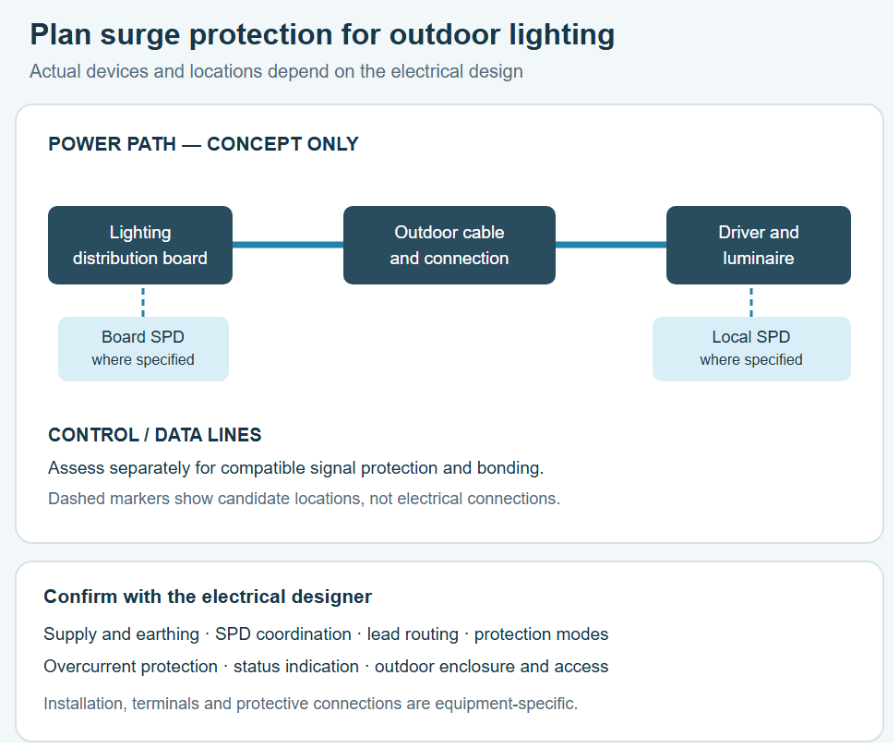
A board SPD may form part of a coordinated arrangement with protection closer to a driver or luminaire. Whether a local device is needed depends on the risk assessment, cable route, installed protection level and equipment documentation. Control and data lines must be assessed separately using devices compatible with their actual voltage, signal and network requirements.
Select the SPD for the installation
The table provides questions for an electrical designer and supplier. It is not a device schedule or a substitute for the project-specific coordination study.
| Design input | What to check | Evidence to request |
|---|---|---|
| Supply and earthing arrangement | Nominal and maximum operating conditions, system configuration, protective conductors, temporary overvoltage and the protection modes required. | Approved single-line diagram and SPD data for the actual system. |
| Exposure and location | Lightning protection arrangement, cable routes, switching sources and where each device is installed. | Risk assessment, installation drawings and selected SPD type and ratings. |
| Luminaire and driver | Exact configuration, declared surge withstand, test waveform and protection modes, insulation class and control interfaces. | Manufacturer’s equipment documentation and installation requirements. |
| SPD performance and coordination | Continuous operating voltage, protection level, discharge or impulse ratings, compatible upstream protection and coordination with other SPDs. | SPD data sheets, installation instructions and coordination information for the proposed devices. |
| Enclosure and maintenance | Outdoor exposure, space, cable routing, access, status indication and failure behaviour. | Enclosure rating and drawings, disconnect or backup protection requirements, and maintenance instructions. |
For AC systems, the designer checks the SPD’s maximum continuous operating voltage (Uc) against the actual system and the relevant manufacturer and installation requirements, including temporary overvoltage conditions. The voltage protection level (Up) is a declared performance characteristic. It must be assessed in the installed circuit, alongside connection effects and the withstand of the equipment being protected. A large discharge-current figure alone does not establish coordination or an adequate protection level.
Type 1, Type 2 and Type 3 describe SPD test classifications under the relevant IEC framework. Depending on the installation, a designer may specify a Type 1 or combined device where lightning-current exposure requires it, Type 2 protection at a distribution board, and additional coordinated protection near sensitive equipment. The type and location are design decisions; products may combine classifications. These SPD types are different from a luminaire’s Class I or Class II electric-shock protection classification.
Check the installed protection, not just the label
Connection leads, routing and the separation between protective devices and equipment can affect the voltage reaching a driver during a transient. Follow the SPD manufacturer’s instructions and the approved design for routing, conductor size, lead length, protective connection, overcurrent protection and coordination. Keep connections as short and direct as the design and instructions require. Do not copy a length limit or fuse size from another product.
Check the luminaire’s insulation class and the SPD’s permitted application. A Class II luminaire may have no protective-earth terminal; use only an SPD and connection arrangement approved for that equipment and installation. Do not add an earth connection to a Class II luminaire unless the manufacturer and applicable requirements explicitly provide for that arrangement.
Outdoor equipment also needs an enclosure, cable entries and connections suitable for the location. The SPD must fit without compromising the enclosure’s environmental protection or the ability to inspect and replace it. The SPD’s installation method and its rated protection depend on its documented assembly conditions.
Account for controls, failure and maintenance
DMX, DALI, Ethernet and other control interfaces have different electrical and signal requirements. Ask the control-system designer whether signal-line protection is required, where boundaries or long outdoor routes occur, and which protective devices preserve the intended signal and equipment compatibility. An AC power SPD does not automatically protect a separate data line.
Ask how each SPD indicates loss of protection and whether its failure disconnects the load or leaves it energized. Devices and arrangements differ. Choose a monitoring and maintenance approach that matches access and the project’s continuity requirements. A light that still operates does not prove that its SPD remains serviceable; a failed light does not identify the cause without investigation.
Record the selected devices, locations, status indication, required upstream protective devices and replacement parts. A qualified person should inspect and maintain the installation under the manufacturer’s instructions and the site’s safety procedure, including after a reported damaging surge or a fault indication. Use appropriate electrical tests; do not attempt to simulate a surge on site without an approved method.
Information to exchange before procurement
Provide the luminaire and SPD suppliers with the site and lightning-protection information, power single-line diagram, earthing arrangement, cable routes and lengths, intended mounting positions, environmental exposure and control architecture. Ask for:
- The exact driver and luminaire configuration, input supply, insulation class and documented surge-withstand test conditions and modes.
- The proposed SPD’s classification, Uc, Up, discharge or impulse ratings, protection modes and any temporary-overvoltage limitations.
- The approved connection diagram, required upstream overcurrent protection, coordination data and any lead-routing restrictions.
- The status indication, end-of-life behaviour, replacement method and environmental requirements.
- For each control interface, compatible signal-protection options and their effect on the network.
For example, CRANE P Single-Module floodlights are listed as an architectural floodlight family with several models. For a proposed outdoor installation, request the exact model’s electrical diagram, driver and surge-withstand documentation, insulation class and any approved SPD arrangement before choosing protective devices. The product page alone does not establish the required SPD or the installed system’s surge performance.
Frequently asked questions
Is a circuit breaker a surge protective device?
A circuit breaker provides overcurrent protection for its intended application. An SPD addresses transient overvoltage. The designer must coordinate any required backup protective device with the SPD manufacturer’s instructions.
Can one SPD at the distribution board protect every outdoor luminaire?
It may be part of a protection scheme, but the designer must assess cable routes, equipment withstand, installed protection level and coordination. A local device may be appropriate where the design and equipment require it.
Does a higher surge-current rating automatically protect a driver better?
No single number establishes compatibility. Review the device’s operating voltage, protection level, protection modes, discharge ratings, installation and coordination against the driver’s documented withstand and the electrical system.
Can an SPD protect a light from a direct lightning strike?
An SPD is one part of a coordinated protection strategy. Direct lightning effects can exceed equipment capabilities; external lightning protection, bonding, installation design and applicable risk assessment must be considered. No absolute protection is implied.
Can an SPD be added to an existing outdoor light?
A qualified designer should check the supply, insulation class, enclosure space, permitted connections, equipment compatibility and existing protection before a retrofit. Follow the luminaire and SPD manufacturers’ instructions.
Does the same SPD work for AC power and DMX or Ethernet?
Do not assume interchangeability. Signal interfaces need compatible protective devices selected for their electrical and communication characteristics, installation and network topology.

Ethan Lee
Project Inquiry
Discuss Your Facade Lighting Project
Tell us about your facade, desired lighting effect and project requirements.