Choose coastal outdoor LED lighting as a complete material and installation system. Assess the site’s salt exposure, wetting, drainage and maintenance access, then review the housing, finish, fasteners, brackets, electrical connections and their interfaces together. An IP rating addresses enclosure protection under defined tests; it does not establish resistance to salt corrosion.
For a credible specification, ask the supplier to identify the exact materials and coating system, provide relevant test reports for the proposed configuration, and state the cleaning and maintenance conditions. A salt-spray test can help assess a coating or control manufacturing quality, but its duration alone cannot predict years of service at a coastal site.
Assess exposure at the actual mounting point
Distance from the coast is only one input. Direct sea spray, prevailing wind, salt deposits, humidity, temperature, industrial pollution and the time surfaces remain wet can all change corrosion exposure. A sheltered soffit may receive salt carried by air but little rain to wash it away. A low-mounted fitting may encounter splashing, irrigation or deposits around its bracket.
Document the exposure for each installation zone. Record orientation, shelter, visible salt accumulation, wetting and drainage, possible chemical exposure and access for cleaning. Where a formal atmospheric corrosivity classification is required, have a qualified specialist determine it from appropriate site data. Do not assign a category solely from a map or a distance-to-shore rule.
Compare materials as part of the assembly
| Candidate | Conditions to investigate | Evidence or action before approval |
|---|---|---|
| Coated aluminium housing | Alloy, pretreatment, coating system, damage at edges and mounting points, and compatibility with adjacent metals. | Obtain coating and test details for the exact assembly; inspect how the finish and fixing interfaces will be maintained. |
| Stainless steel housing or hardware | Exact grade and surface finish, chloride exposure, crevices, drainage and cleaning access. | Confirm grade and finish, and assess the location and maintenance plan. Even 316 stainless steel can stain or corrode in severe conditions. |
| Brass or bronze components | Exact alloy, finish, appearance over time, contact with other metals and project exposure. | Obtain the material specification and check adjoining materials, runoff and the maintenance requirements. |
| Polymer components | UV exposure, temperature, mechanical loading, chemical compatibility and ageing. | Confirm the product’s material specification and suitability for the actual mounting and environmental conditions. |
A material name alone is not a service-life guarantee. The bracket and fasteners may use different materials from the housing. Request the full material and finish schedule and compare it with the installation section and cleaning plan.
Check fasteners, interfaces and drainage
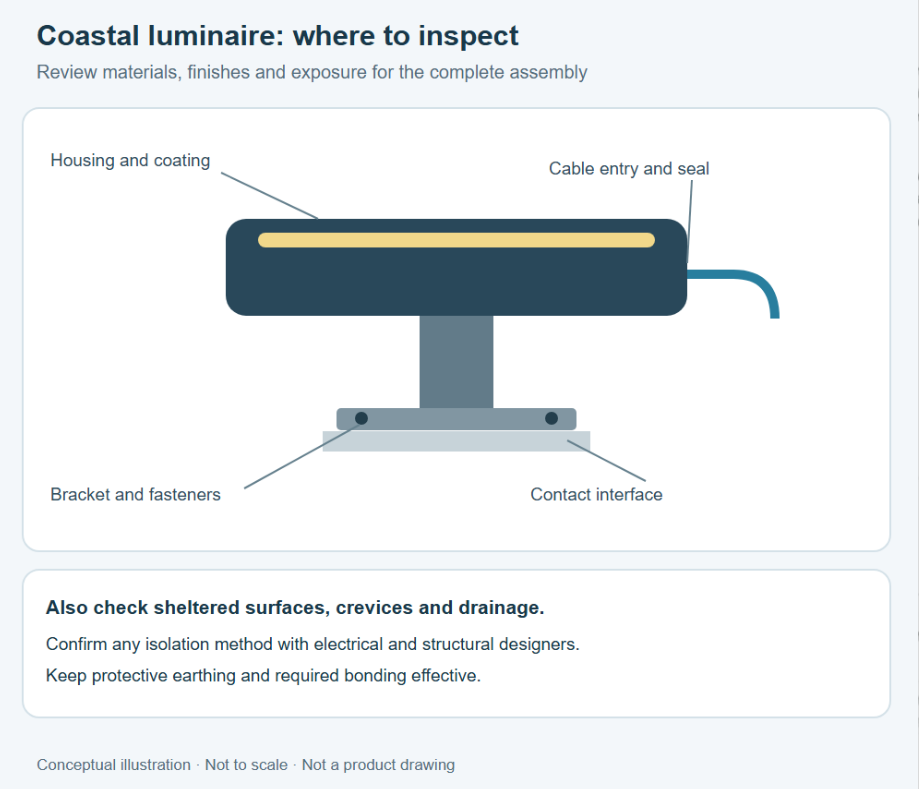
When dissimilar metals are electrically connected and share a conductive wet environment, galvanic corrosion can accelerate attack on one metal. The risk depends on the metals, their relative exposed areas, the electrolyte and how long the joint stays wet. Crevices and areas that retain salt deposits deserve attention even when the housing itself has a suitable finish.
Ask the luminaire supplier and project engineer to review housing-to-bracket, fastener-to-bracket and bracket-to-building interfaces. Where separation or a protective treatment is proposed, confirm the full assembly, including fastener sleeves and washers where applicable. Any corrosion isolation must be coordinated with the electrical and structural design so protective earthing, required bonding and mechanical integrity remain effective. Do not add insulating parts or coatings to an installed assembly without that review.
Avoid creating unnecessary water traps and follow the manufacturer’s instructions for mounting orientation, drainage, cable entries and approved fixings. Do not drill extra drainage holes or block designed vents without written product guidance. Inspect coating damage at cut edges, fixings and contact points using the manufacturer’s repair procedure.
Read salt-spray reports with the right questions
A salt-spray report is useful when it identifies what was tested and how the result was judged. It is not a direct conversion from test hours to years by the sea. ISO 9227 describes several salt-spray methods and states that they are not intended to predict long-term corrosion resistance or rank different materials for service life.
Request the test method and version, specimen identity, substrate and finish, preparation, exposure duration, condition of edges or deliberate damage, evaluation method, acceptance criteria and actual result. Check whether the specimen represents the proposed product, production finish, fasteners and assembled interfaces. A coated test panel does not on its own establish the performance of a complete luminaire.
For example, if a report covers only a coated aluminium panel while the proposed wall washer uses a different bracket and exposed fasteners, use the report as evidence for that panel and ask for separate information about the bracket, fasteners and joint. Do not approve the whole assembly on the panel result alone.
Build a maintenance and procurement checklist
Before ordering, document the environmental conditions and send the supplier the mounting section, expected service exposure and maintenance access. Ask for:
- The exact model and configuration, with housing, bracket, fastener and accessory materials.
- Finish details, including surface preparation, coating or treatment, and the approved repair method.
- Relevant corrosion test reports and acceptance criteria, identifying the tested specimen and method.
- Details of dissimilar-metal interfaces, approved fixings and any manufacturer-approved isolation measures.
- Environmental ratings and instructions for the luminaire, cable entries and separate electrical connections.
- Cleaning products and methods, inspection guidance, replacement parts and any coastal warranty conditions that apply to the exact configuration and site.
For example, CRANE HL Slim-Width wall washers are listed with a 6063 aluminium-alloy housing. The page identifies a product candidate for a facade with limited mounting space; it does not by itself establish suitability for a particular coastal exposure. Before approval, request the exact model’s coating system, bracket and fastener materials, interface details, relevant test reports and cleaning instructions. Compare the evidence against the actual location and project requirements.
Set an inspection and cleaning plan with the supplier and asset owner based on exposure and access. Look for deposits, coating damage, pitting, staining, seized fasteners, deterioration around cable entries and water traps. Use only cleaning methods approved for the product, and adjust the inspection frequency from observed conditions. Refer electrical defects or suspected water ingress to a qualified professional for safe isolation and assessment.
Frequently asked questions
Does IP67 mean a light is suitable for a seaside installation?
IP67 addresses dust and temporary immersion under defined conditions. It does not establish resistance to salt corrosion. Assess the materials, finish, interfaces and maintenance plan separately.
Is 316 stainless steel immune to coastal corrosion?
No. Its performance depends on exposure, surface condition, joint design and maintenance. Severe chloride exposure or trapped deposits may require a different material or additional design measures.
Is a higher salt-spray test duration enough to select the best product?
No. Compare the method, specimen, coating, preparation and evaluation criteria first. A laboratory exposure duration alone does not predict service life or establish how a complete installed assembly will perform.
Can I add plastic washers under the bracket to stop galvanic corrosion?
Only use an isolation detail approved for the complete installation. A washer alone may not isolate all contact paths, and changes must preserve structural performance, protective earthing and required bonding.
Does a sheltered location eliminate salt corrosion?
No. A sheltered surface can accumulate airborne salt while receiving little natural rain washing. Inspect actual deposits, wetting and access before selecting a maintenance plan.
Can a damaged coastal coating be repainted on site?
Ask the manufacturer for the approved assessment and repair method. The suitable repair depends on the coating system, substrate, extent of damage and exposure. Replace components where the approved repair cannot restore the required condition.

Ethan Lee
Project Inquiry
Discuss Your Facade Lighting Project
Tell us about your facade, desired lighting effect and project requirements.