Choose an outdoor LED light for the water exposure at its actual installation point. IP65 addresses dust and water jets, IP66 addresses dust and powerful water jets, and IP67 addresses dust and temporary immersion under specified test conditions. If a fitting can experience both powerful jets and temporary immersion, request evidence for both IP66 and IP67. An IP67 marking alone does not establish IP66 jet protection. For prolonged immersion, assess an appropriately specified IP68 product and its declared conditions.
An IP rating describes protection provided by an enclosure under defined tests. It does not, on its own, confirm corrosion resistance, impact strength, electrical safety, suitability for a particular mounting position, or the protection of separate connections.
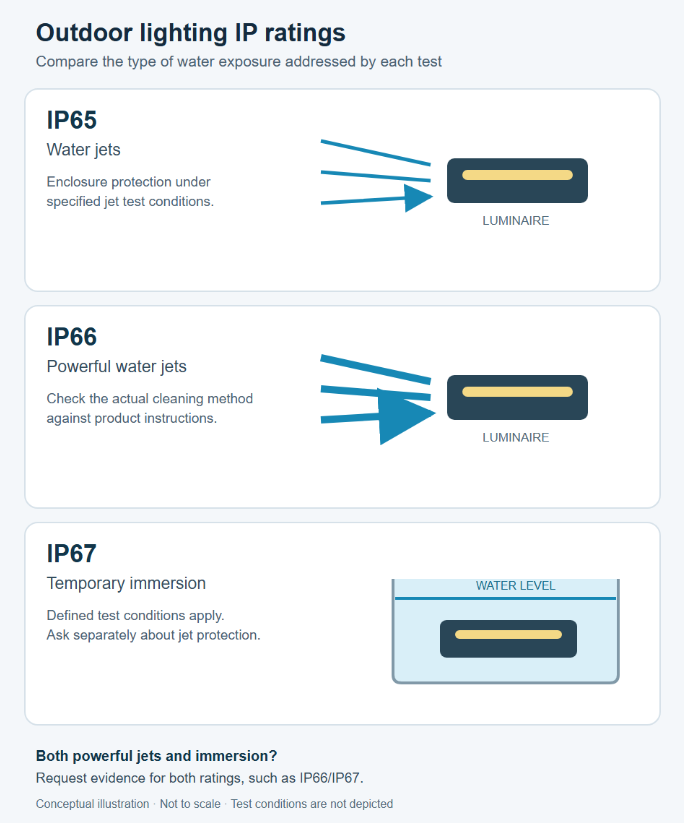
Figure 1. Water exposures addressed by IP65, IP66 and IP67. Conceptual illustration, not to scale; test conditions are not depicted.
What the ratings mean
All three ratings have a first digit of 6, indicating dust-tight protection. The second digit describes a different water test.
| Rating | Water exposure addressed | What to check |
|---|---|---|
| IP65 | Water jets under the specified test conditions | Whether the expected cleaning and exposure fit the product instructions and test conditions. |
| IP66 | Powerful water jets under the specified test conditions | The actual cleaning equipment, nozzle distance and method. The rating is not approval for every pressure washer. |
| IP67 | Temporary immersion under the specified test conditions | Whether the installation could remain submerged longer, deeper or under different conditions. Ask separately about jet protection. |
The water test permits no harmful effects under its acceptance conditions. It should not be interpreted as proof that an enclosure will remain dry in every service condition. IEC 60529 defines the IP code. Luminaire safety and installation requirements must also be checked against the applicable product standards and local rules.
Match the rating to the exposure, then check the assembly
Use the most demanding credible exposure at each component, including cleaning and foreseeable drainage problems. For facade-mounted LED wall washer lights, check the exact model and its exposure before selecting a rating. The table is an initial specification method, not a substitute for product instructions or a site assessment.
| Installation condition | Initial requirement to investigate | Before approval |
|---|---|---|
| Exposed facade fitting subject to rain and ordinary washing, with no expected pooling | Evaluate an IP65 fitting against the proposed water exposure. | Confirm mounting orientation and the cleaning method with the supplier. |
| Fitting in the path of a strong cleaning jet | Evaluate IP66 for the fitting and exposed connection system. | Compare the actual nozzle, pressure, distance, temperature and chemicals with the manufacturer’s instructions. |
| Ground-level fitting that may temporarily sit in pooled water | Evaluate IP67 for the parts that may be immersed. | Establish expected water depth and duration, drainage and the suitability of the exact mounting arrangement. |
| Fitting exposed to both powerful jets and temporary pooling | Request IP66 and IP67 evidence, such as a dual IP66/IP67 marking supported by documentation. | Confirm that the same assembled configuration, including its connections, covers both exposures. |
| Water is likely to remain around the fitting or the fitting is intentionally submerged | Evaluate a product expressly suitable for the intended immersion, including an IP68 rating with declared conditions. | Confirm depth, duration, water chemistry, connections, maintenance and any applicable electrical requirements. |
For example, one of the LED in-ground lights installed in a paved area may encounter both wash-down water and temporary pooling after a blocked drain. Its selection should account for both. The luminaire body, cable entry and any accessible connector may face different exposure. Map each location on the installation drawing, request the relevant ratings and instructions, then inspect drainage and installation details before acceptance. If the expected pooling duration is unknown, the rating alone cannot resolve the selection.
Check connectors, cable entries and drainage
An IP-rated luminaire is one part of an installation. A separately supplied connector, junction box, driver enclosure or cable gland has its own conditions and rating. Check each component at the location where it will be installed, including whether connectors are fully mated, unused ports are capped and the permitted cable diameter matches the seal.
Follow the manufacturer’s instructions for orientation, cable routing, sealing, fasteners and access for maintenance. A connection installed in a low point can experience pooling even when the luminaire is mounted above it. A recessed fitting may require a drainage arrangement specified by its manufacturer. Record the proposed section and drainage path, and resolve conflicts before installation.
Do not assume that applying sealant to a joint will reproduce a tested assembly. Confirm the approved method and replacement parts with the manufacturer, especially after a fitting has been opened for service.
Consider weathering, cleaning and service life separately
The IP code is not a corrosion, UV-resistance or mechanical-impact classification. Coastal salt, cleaning chemicals, temperature cycling and physical damage can affect materials and seals during service. Ask for material and finish information, the permitted cleaning method and any relevant test evidence for the project environment. For impact exposure, specify the appropriate impact requirement separately.
Visible condensation also needs investigation rather than an automatic diagnosis. Ask the manufacturer whether the observed condition is consistent with the product design and service conditions. Standing water, repeated accumulation, damage or electrical symptoms warrant isolation and assessment by qualified personnel under the site’s safety procedures.
What to request before placing an order
Give the supplier a drawing or schedule showing each luminaire, connector and driver location. Include expected rain exposure, cleaning method, potential water accumulation, drainage, access and environmental conditions. Request:
- The exact model and configuration, including mounting orientation, cable entry and accessories.
- The declared IP rating for the supplied assembly and separate components, including both jet and immersion ratings where both are required.
- Applicable product data, installation instructions and supporting test documentation identifying the configuration and standard used.
- The permitted cleaning procedure and any restrictions on pressure, temperature, chemicals and nozzle distance.
- For immersion-rated products, the intended immersion conditions and any drainage or mounting restrictions.
- The procedure and parts needed to restore the assembly after maintenance.
Compare the submitted information with the actual installation. If a component, attachment or exposure is missing from the evidence, resolve it before approving a substitution.
Frequently asked questions
Does IP67 mean a light can be used underwater permanently?
IP67 addresses temporary immersion under defined test conditions. For intended prolonged immersion, ask for a product suitable for that use and check its declared IP68 conditions and the applicable installation requirements.
Can I pressure-wash an IP66 light at close range?
IP66 describes a standardized powerful-jet test. A commercial washer can differ in nozzle, distance, pressure, temperature and chemicals. Follow the product’s cleaning instructions and obtain written confirmation for the proposed method.
Does an IP67 connector make the whole installation IP67?
No single component establishes the rating of an entire installation. Check the assembled connector, cable entry, enclosure and other exposed components in their installed conditions, including any manufacturer restrictions.
Does IP65 or IP67 indicate resistance to seawater?
The IP code does not establish corrosion resistance. Evaluate water chemistry, materials and protective finishes separately, and obtain relevant manufacturer evidence for the intended environment.
Can an IP-rated light be opened and resealed on site?
That depends on its construction and service instructions. Ask whether the assembly is serviceable, which seals and parts are required and how the manufacturer expects it to be reassembled and checked.
Is an IP rating the same as a wet-location approval?
They describe different aspects of product suitability. Check the approval and installation requirements applicable to the destination market as well as the IP rating and product instructions.
Discuss your outdoor lighting installation
Contact CRANE with the installation drawing, expected water exposure, cleaning method and any immersion or drainage concerns. Ask for the exact luminaire and connection documentation needed to assess the proposed installation.

Ethan Lee
Project Inquiry
Discuss Your Facade Lighting Project
Tell us about your facade, desired lighting effect and project requirements.